
(Without Buying a New Curriculum)
Many parents discover the idea of living learning and feel inspired — but also overwhelmed.
Do we need to replace all our books?
Buy an entirely new curriculum?
Start over completely?
The good news is: you don’t have to.
Living learning is not about purchasing something new. It is about shifting the way we approach learning — inviting children into ideas instead of simply assigning tasks.
Small changes can transform the atmosphere of your homeschool day. Here are five simple ways to begin.
1. Begin With a Question
Instead of starting a lesson by explaining everything, begin with curiosity.
Questions awaken attention. They invite children to participate rather than passively receive information.
Before studying a topic, try asking something simple like:
- “Why do you think the prairie has such deep roots?”
- “How does your body know where to send blood?”
- “Why do birds migrate when seasons change?”
Children naturally begin forming ideas before the lesson even begins. When we ask questions first, learning becomes a discovery instead of a requirement.
2. Choose Living Books
One of the central ideas of living learning is the use of living books.
Living books are written by authors who care deeply about their subject. They tell stories, present ideas, and allow the reader to form a relationship with the material.
Instead of reading dry summaries or textbook bullet points, children encounter history through narrative, science through observation, and nature through story.
A single well-written book often sparks more interest and understanding than pages of condensed facts.
3. Replace Worksheets With Narration
In many traditional classrooms, learning ends with a worksheet.
Living learning takes a different approach.
After reading or studying something together, ask your child to tell back what they remember. This practice is called narration.
Narration is not the same as answering comprehension questions. Instead of asking children to recall specific details, narration invites them to share what stood out to them — the ideas they remembered, the moments that captured their attention, or the connections they made.
Narration can look like:
- Telling the story in their own words
- Drawing a picture of what they learned
- Acting out an event
- Writing a short summary (for older children)
Because narration reflects what a child noticed and understood, there are no wrong answers. Each child will remember different details, and those differences often reveal the ideas that spoke most strongly to them.
Over time, narration strengthens attention, memory, and the ability to express ideas clearly.
4. Add Notebooking
Notebooking is a natural extension of narration and observation.
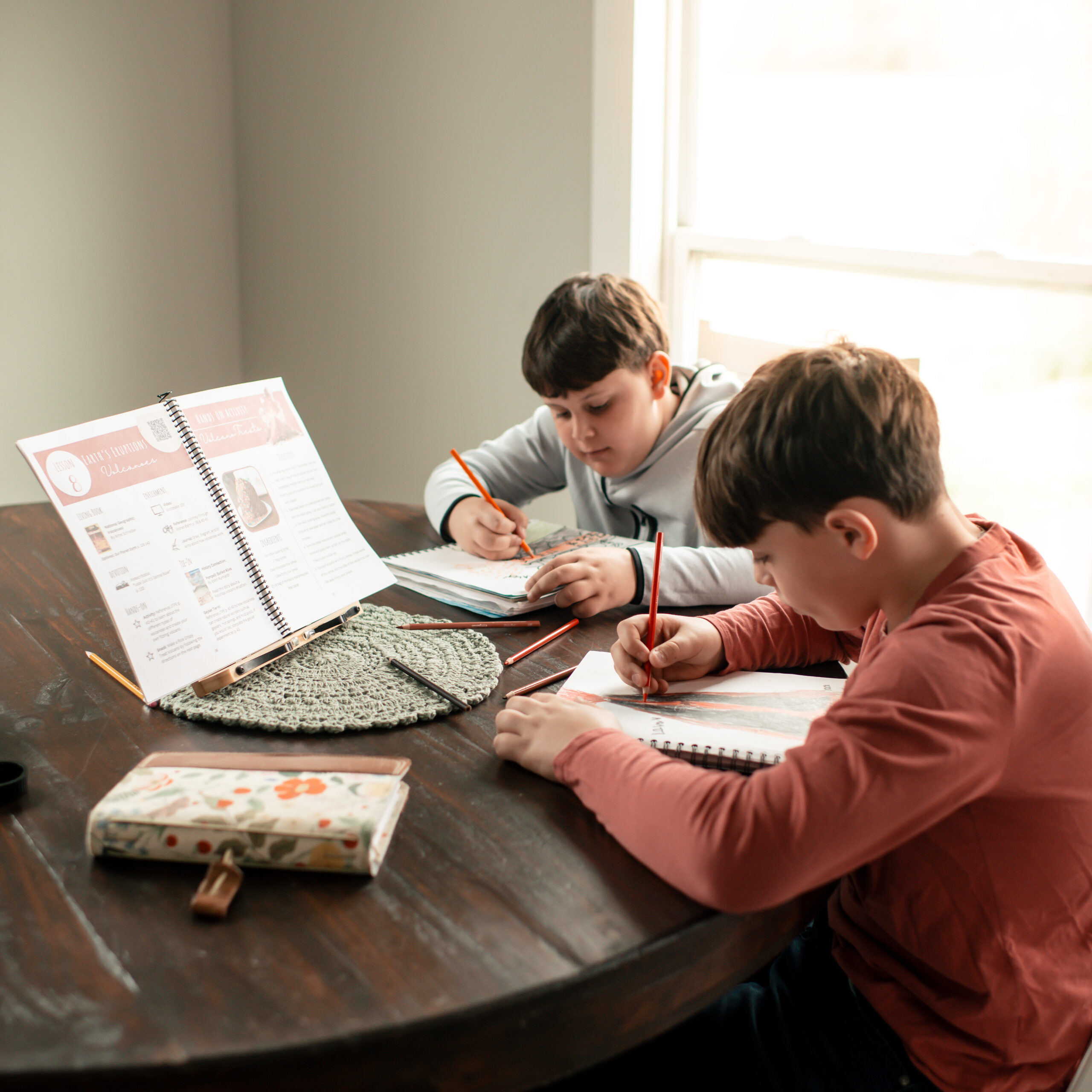
Instead of filling out pre-made worksheets, children record what they are learning in their own notebooks or journals. This might include sketches, written narrations, labeled diagrams, or personal reflections.
A notebook becomes a place where ideas are gathered and revisited over time.
Children might include things like:
- A drawing of a wildflower observed during nature study
- A labeled diagram of the human heart
- A short written narration after reading a chapter
- A list of interesting facts discovered during a lesson
- A diagram of the layers of soil with layers labeled
Like narration, notebooking does not have a single correct answer. Each child’s notebook will look different because it reflects their own observations and ideas.
Over time, these notebooks become a meaningful record of learning — a collection of discoveries, questions, and growing understanding.
5. Take Learning Outdoors
Some of the richest learning happens beyond the table.
Nature study allows children to observe the world directly — noticing patterns, relationships, and beauty that cannot be fully captured in a book.
A short walk can become a lesson in science, geography, art, and wonder all at once.
Children might notice:
- The structure of a wildflower
- Birds building nests
- The way wind moves through tall grass
- How insects interact with plants
These observations naturally lead to questions, discussions, and deeper curiosity.
A Simple Living Learning Morning
Living learning does not require complicated schedules or expensive materials. A morning can unfold gently, guided by curiosity and attention.
Here is what a simple living learning morning might look like:
Morning Read Aloud
Begin the day by reading a chapter from a living book together. This might be a history story, a nature book, or literature. After reading, ask your child to narrate what stood out to them.
Notebooking
Invite your child to record something from the lesson in a notebook. They might write a few sentences, sketch something they remember, or create a labeled diagram.
Ask a Question
Introduce the next lesson with a simple question.
“What do you think happens to your breathing when you run?”
“Why do some plants grow deeper roots than others?”
Allow your child to think about the question before exploring the topic together.
Nature Observation
Step outside for a short walk or time in the yard. Notice what is growing, flying, or changing with the season.
Children might sketch something they observe, collect a leaf, or simply talk about what they see.
Closing Reflection
Before ending the morning, ask a simple question:
“What was the most interesting thing you learned today?”
This small habit helps children recognize that learning is something they actively participate in.
Start Small
You do not need to transform your homeschool overnight.
Try beginning with just one change:
Ask more questions.
Add a living book to your week.
Replace one worksheet with narration.
Start a simple notebook.
Take a short walk together.
Living learning grows slowly and naturally, much like curiosity itself.
And often, the smallest shifts create the most meaningful moments.
🌿 At Untethered Press, we believe learning should awaken curiosity, invite exploration, and create lasting connections with the world around us.
Untethered Press
Leave a Reply